AI copilot for R&D
A research assistant that shows its sources
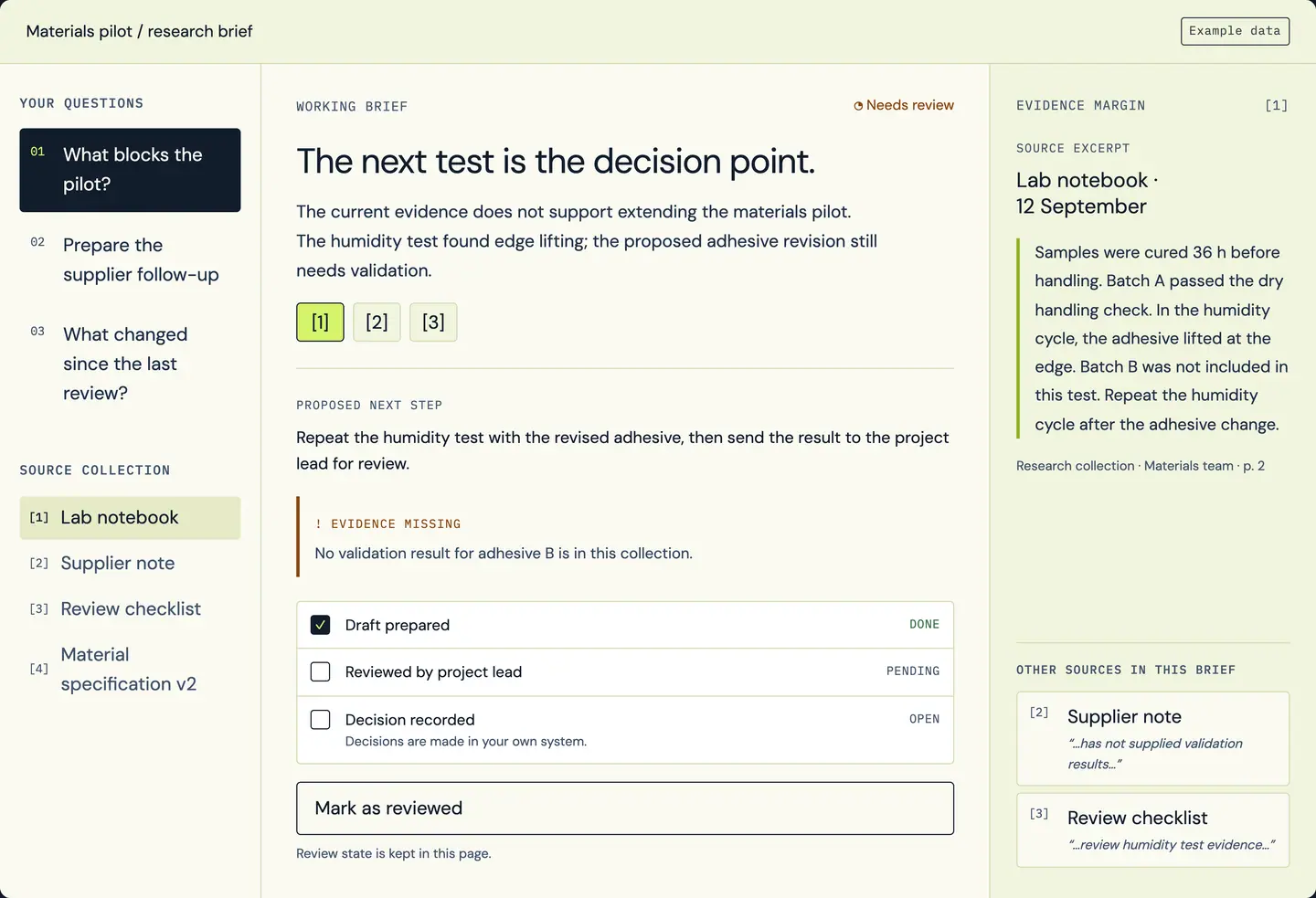
Research teams lose hours looking for the paper someone read last year, the lab note that contradicts it, or the test report buried in a shared drive. We build a research copilot that indexes those sources, answers questions in plain language and links each statement to the page, figure or record it came from. Where it helps, we also build a knowledge graph of the relationships between materials, methods, results and people. Each link is marked as either taken directly from a document or inferred by the system. Researchers can draft literature summaries, compare experimental conditions and sketch experiment plans, then check every claim against the original. Access follows your existing folder and project permissions, so confidential programmes stay with the people cleared to see them.
What your team receives
- Connectors and indexing for your chosen sources: papers, lab notebooks, reports, shared drives
- Search and question-answering interface with page-level citations
- Knowledge graph of entities and relationships, labelled as extracted or inferred
- Templates for literature summaries, comparison tables and experiment plans
- Market and standards watch: comparison tables with every source linked
- Permissions carried over from your existing folders and projects
Example scenario
A materials team has 400 PDFs, five years of lab notebooks and a spreadsheet of test results. A researcher asks which binder ratios were tested above 80°C. The copilot replies with a table that lists each condition and its result, with a link to the notebook page or paper figure it came from. Two rows are flagged as inferred from indirect wording, so the researcher checks those first.
What you control
Data protection
Map approved data sources, access rules, retention and provider use before connecting AI to company information.
EU infrastructure options
Scope EU servers or self-hosting and disclose the processing location of model APIs, logs and backups.
Human approval
Agree where AI may suggest, where it may act and where a person must approve the next step.
How a project runs
Understand the work
We sit with the people who do the work, map the documents and systems involved, and agree on what “done” means before anything is built.
Ship a first testable version
A first version on your real data, early, not a slide deck. You test it with your team; we change it from what you see.
Get it ready to run
Permissions, backups, monitoring, documentation and training, so the system keeps working when we’re not in the room.
Stay after launch
Updates, fixes and legislative changes under the monthly licence; new work only against estimates you approve in writing.
Pairs with
Questions
Can we start small?
Yes. Start with one workflow, one team and an agreed outcome. We scope the pilot after learning about your data, systems and constraints.
Can our data stay in the EU?
We can scope EU-hosted or self-hosted options. The proposal identifies where each component processes and stores data, which providers are involved, and any transfer or remote-access implications. EU hosting alone does not establish compliance.
Can we use the tools we already have?
We start with your current workflow and systems. The proposal identifies the integrations, data access and handoffs needed for a useful first deliverable.
Guides
AI copilot for R&D: scope an implementation pilot for your team
Scope an AI copilot for R&D around one research task, approved sources, reviewer checks and measurable pilot outcomes for a small technical team.
From scattered technical files to a research brief with sources
Build research briefs that connect technical claims to pages, tables and document revisions, with explicit handling of conflicts and reviewer decisions.
When the knowledge assistant finds two versions of the answer
Make AI knowledge search distinguish current, future and historical document versions, exposing conflicting instructions and the owner who resolves them.
Proposal for AI copilot for R&D
Tell us about the work, the people and the systems involved. We agree the first deliverable, data boundaries, scope and budget before work begins.
Request a proposal