Document AI pilot
Testing extraction on your own files, then building it
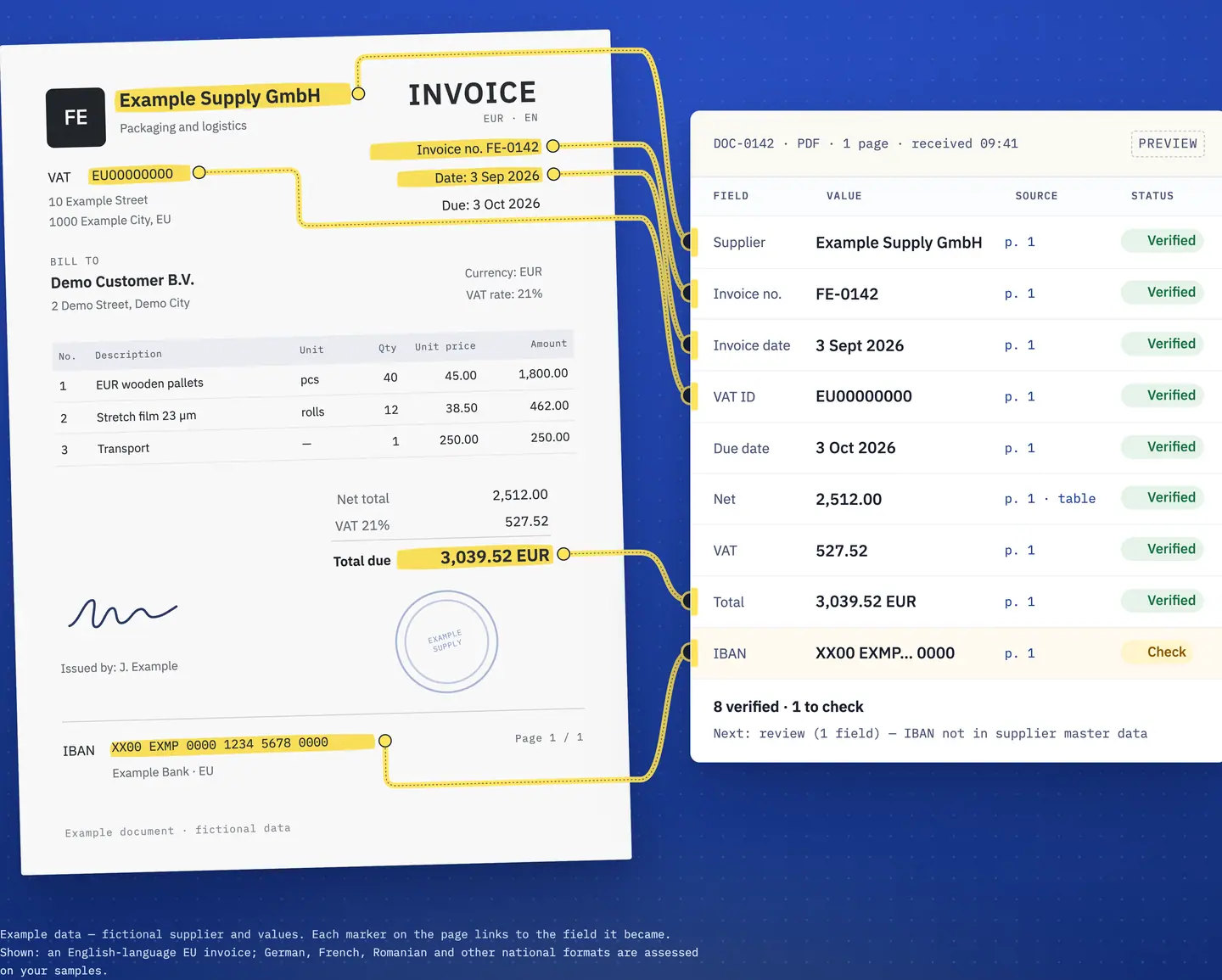
Document extraction looks easy on a clean demo PDF and gets harder with real files. Think crooked scans, tables split across pages, handwritten notes in the margins and the same form in four versions. We start with a sample of documents your team has already checked by hand and compare a few approaches on it, from OCR and layout parsing to vision-language models. Each extracted field keeps a pointer to the page and region it came from, along with review flags, so a reviewer can check it against the original without hunting through the file. You see where each approach works and where it fails, with examples. Then we agree on the output structure, the review threshold and where the data should go, and build the production pipeline.
What your team receives
- Agreed sample set with hand-checked reference values
- Comparison of extraction approaches, with examples of failures
- Output schema with a page and region reference for every field
- Review screen for low-confidence fields
- Production pipeline into your ERP, database or document system
Example scenario
A logistics company receives customs declarations, delivery notes and carrier invoices, many of them as phone photos. Its team has 150 documents already checked by hand. We run three extraction approaches against them and show where each one misreads stamps or rotated tables. Fields such as gross weight and tariff codes go to a reviewer when confidence is low, and approved records are written to the shipment entry in the ERP.
What you control
Data protection
Map approved data sources, access rules, retention and provider use before connecting AI to company information.
EU infrastructure options
Scope EU servers or self-hosting and disclose the processing location of model APIs, logs and backups.
Human approval
Agree where AI may suggest, where it may act and where a person must approve the next step.
How a project runs
Understand the work
We sit with the people who do the work, map the documents and systems involved, and agree on what “done” means before anything is built.
Ship a first testable version
A first version on your real data, early, not a slide deck. You test it with your team; we change it from what you see.
Get it ready to run
Permissions, backups, monitoring, documentation and training, so the system keeps working when we’re not in the room.
Stay after launch
Updates, fixes and legislative changes under the monthly licence; new work only against estimates you approve in writing.
Pairs with
Questions
Can we start small?
Yes. Start with one workflow, one team and an agreed outcome. We scope the pilot after learning about your data, systems and constraints.
Can our data stay in the EU?
We can scope EU-hosted or self-hosted options. The proposal identifies where each component processes and stores data, which providers are involved, and any transfer or remote-access implications. EU hosting alone does not establish compliance.
Can we use the tools we already have?
We start with your current workflow and systems. The proposal identifies the integrations, data access and handoffs needed for a useful first deliverable.
Guides
Evaluate document AI on the files your team actually receives
Evaluate document AI against checked real files, field errors and reviewer effort, then choose extraction and review rules from evidence your team can inspect.
Let reviewers open the exact page behind an extracted field
Connect extracted fields to exact pages and regions, preserve correction history and test a review interface that helps people confirm values in context.
Proposal for Document AI pilot
Tell us about the work, the people and the systems involved. We agree the first deliverable, data boundaries, scope and budget before work begins.
Request a proposal